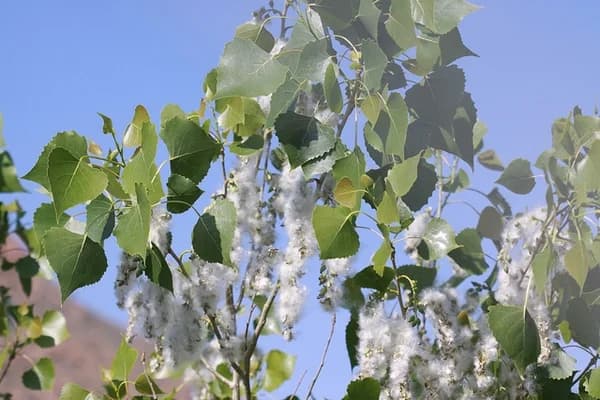
Leaves
Alternate, triangular leaves have coarse teeth and pointed tips. Flattened leaf stalks help foliage flutter. Compare bark and buds with other poplars; leaf movement alone is not identification.
Eastern Cottonwood · Populus deltoides
Watch what moves. Notice what remains beneath it.
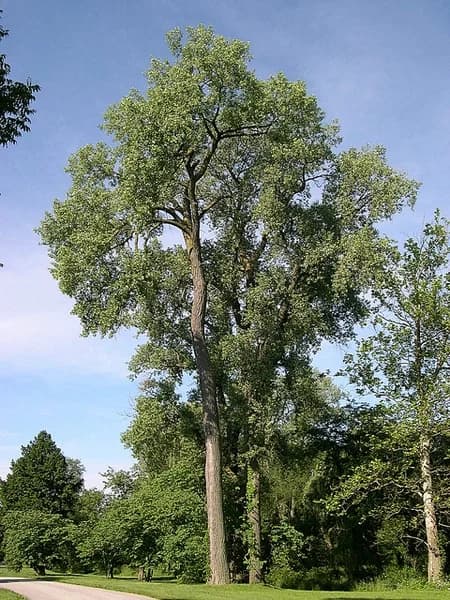
01 · Meet the tree
Cottonwood offers movement through foliage, drifting seeds, and changing light. You can meet that movement from a still, comfortable place. The practice asks you to notice change without chasing it or forcing yourself to feel calm.
Alternate, triangular leaves have coarse teeth and pointed tips. Flattened leaf stalks help foliage flutter. Compare bark and buds with other poplars; leaf movement alone is not identification.
Mature bark develops deep ridges and furrows. Female trees release seeds with cotton-like hairs. Male and female catkins occur on separate trees, so not every cottonwood produces cotton.
Native across much of North America, cottonwood often grows near rivers and bottomlands. Its wood can be brittle. Observe from stable ground away from damaged limbs; avoid floodwater, eroding banks, and windy conditions.
Compare several features, and notice how age and season change their appearance. These photographs are starting points for observation; leave living leaves, needles, cones, and bark attached.
Catkins appear before leaves in spring. Female trees later release fluffy seeds; summer foliage moves in breezes. Leaves often turn yellow in autumn. Winter reveals bark and branching. Still weather offers a different encounter, not a failed visit.
Botanical reference: NC State Extension’s eastern cottonwood profile. This is a starting point for observation, not a complete identification key.
02 · Energy & character
Three qualities to contemplate beside the tree. Begin with what you can observe, then see what meaning emerges for you.
These tree-specific associations are new contemplative interpretations for the digital school. “Energy” here describes felt experience and symbolism; it is not a measured healing field or a promise of a particular effect.
Leaves and their shadows change position in a breeze.
Observe movement without needing to follow every change.
Can you let movement occur without chasing it?
The tree presents different forms through the seasons.
Consider one change already happening in your life and one response within your control.
What is changing, and what can you choose?
The trunk remains a visible reference beneath moving foliage.
Use one steady detail to orient attention while allowing the larger scene to change.
What helps you find your place?
03 · Practice with this tree · About 5 minutes
An original five-minute observation practice. Read once, then give your attention to the tree; sitting, standing, or observing from a distance are equally welcome.
Open outdoor practice →Sit or stand with your normal supports on a permitted path, clear of river edges and damaged branches. Postpone the practice in strong winds or storms.
Notice a leaf or shadow shifting without tracking it with your whole body. If the air is still, watch the light or simply observe a leaf.
Bring attention to a patch of trunk, then include the moving scene again. Let your breathing continue naturally.
Acknowledge a change in your day and choose one practical response. Finish by noticing the ground and surroundings before moving on.
Spend about five minutes, or less if that suits you. Keep your device available when needed. No touching, collecting, controlled breathing, or tree-supported movement is required; leave the tree and its surroundings undisturbed.
04 · Roots in the book
The book teaches attention and learning from trees. This page adds a species-specific encounter; it does not claim that the original book assigned these three energies to eastern cottonwood.
Chapter 3 introduces three pathways and choosing an appropriate setting.
Read the chapter companionOriginal: printed pp. 13–17Chapter 4 encourages a sustainable beginning with five or ten minutes.
Read the chapter companionOriginal: printed p. 28Adaptability, presence, and balance connect this new practice with Chapter 6’s invitations to learn from trees.
Explore Wisdom and WonderOriginal: Chapter 6, printed pp. 96–12405 · Notice for yourself
Reflect quietly or write a sentence in your own notebook. On another visit, look at the same detail again. Your experience may fit these themes, suggest something different, or simply be a few minutes of looking.