Leaves
Alternate leaves are simple, with toothed margins and an uneven base. Compare the leaf with bark and fruit; related sugarberry can look similar.
Common hackberry · Celtis occidentalis
Notice texture and the life around it. Find one ordinary way to care.
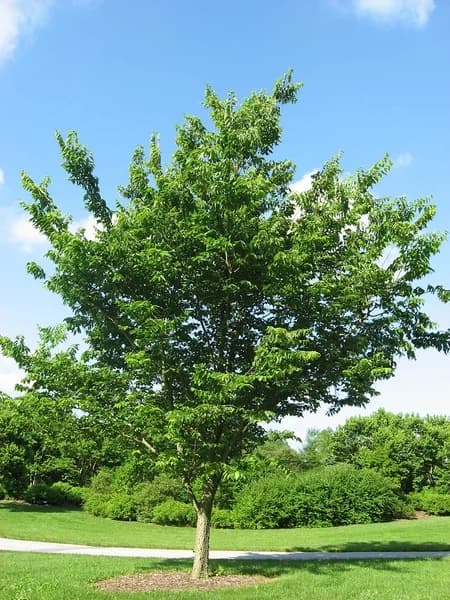
01 · Meet the tree
Hackberry's corky bark and arching branches offer details worth meeting slowly. Its fruit supports wildlife. Begin with this individual tree and its surroundings, allowing a lesson to grow from observation.
Alternate leaves are simple, with toothed margins and an uneven base. Compare the leaf with bark and fruit; related sugarberry can look similar.
Older bark commonly develops distinctive corky ridges and wart-like projections. Small round fruits turn reddish to purple. Observe fruit where it grows or lies; leave it for wildlife.
Common hackberry is native to central and eastern North America and occurs in bottomlands and other wooded sites. It is also planted as a shade tree and tolerates varied soils and urban conditions.
Compare several features, and notice how age and season change their appearance. These photographs are starting points for observation; leave living leaves, needles, cones, and bark attached.
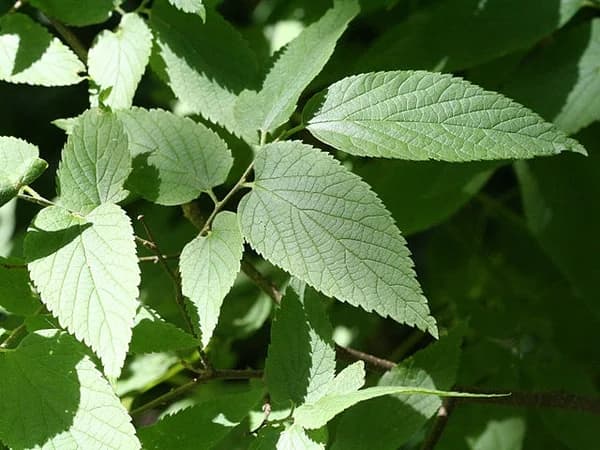
Spring brings small flowers and new leaves. Summer reveals the foliage and developing fruit. Autumn fruit darkens and leaves change before falling. Winter offers a clearer view of corky bark and arching branches, while some fruit may remain for wildlife.
Botanical reference: NC State Extension’s common hackberry profile. This is a starting point for observation, not a complete identification key.
02 · Energy & character
Three qualities to contemplate beside the tree. Begin with what you can observe, then see what meaning emerges for you.
These tree-specific associations are new contemplative interpretations for the digital school. “Energy” here describes felt experience and symbolism; it is not a measured healing field or a promise of a particular effect.
The tree stands within conditions that include weather and nearby human activity.
Use its setting to consider what helps you continue. Resilience can include protection, support, and rest rather than bearing everything alone.
What would help you continue with care?
Bark texture and small fruits become distinct when you slow down.
Let close attention prompt a modest act of care. You need not alter the tree to appreciate it.
What deserves a little more attention?
Fruit, branches, and surrounding habitat can support other living things.
Consider one relationship that helps sustain your day. Connection can begin with noticing and responding to a small need.
Who or what could you care for today?
03 · Practice with this tree · About 5 minutes
An original five-minute practice joining careful observation with resilience and connection.
Open outdoor practice →Choose a permitted seat or stable standing place clear of damaged limbs. Use your usual supports and keep your eyes at a comfortable angle.
Choose a patch of bark or a visible leaf. Follow one ridge or edge with your eyes. Touch is optional and unnecessary; leave bark intact.
Widen your view to nearby plants, light, and any wildlife present. Notice without approaching or disturbing animals. Keep your breathing natural.
Choose one small act that could support you or another living thing. Make it realistic for today, then return to the whole scene before finishing.
Spend about five minutes, or less if that suits you. Keep your device available when needed. No touching, collecting, controlled breathing, or tree-supported movement is required; leave the tree and its surroundings undisturbed.
04 · Roots in the book
The book teaches attention and learning from trees. This page adds a species-specific encounter; it does not claim that the original book assigned these three energies to hackberry.
Chapter 3 introduces three pathways and choosing an appropriate setting.
Read the chapter companionOriginal: printed pp. 13–17Chapter 4 encourages a sustainable beginning with five or ten minutes.
Read the chapter companionOriginal: printed p. 28Presence, compassion, and balance and optimization connect this new practice with Chapter 6’s invitations to learn from trees.
Explore Wisdom and WonderOriginal: Chapter 6, printed pp. 96–12405 · Notice for yourself
Reflect quietly or write a sentence in your own notebook. On another visit, look at the same detail again. Your experience may fit these themes, suggest something different, or simply be a few minutes of looking.