Leaves
Alternate, pinnately compound leaves commonly have seven to nine toothed leaflets. Check the whole leaf attachment when comparing it with other hickories.
Bitternut Hickory · Carya cordiformis
Look closely before deciding. Let understanding grow at its own pace.
01 · Meet the tree
Bitternut hickory invites attention to small distinguishing features rather than a quick resemblance. A yellow bud or a compound leaf can become a reminder to separate observation from assumption. Patience here is a way of looking, not a test of endurance.
Alternate, pinnately compound leaves commonly have seven to nine toothed leaflets. Check the whole leaf attachment when comparing it with other hickories.
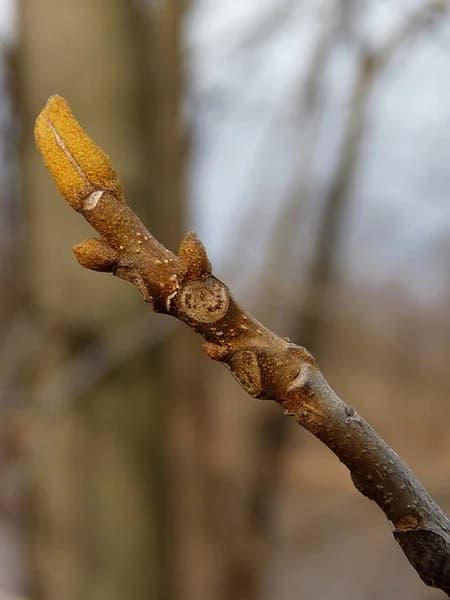
Sulfur-yellow terminal buds are a particularly useful identifying feature. Nuts have thin husks and bitter kernels; do not taste unknown nuts to identify a tree.
Native to eastern North America, bitternut hickory often grows on moist, rich soils. Compare buds, leaves, and fruit across seasons. Its bark is unlike the long peeling strips of shagbark hickory.
Compare several features, and notice how age and season change their appearance. These photographs are starting points for observation; leave living leaves, needles, cones, and bark attached.
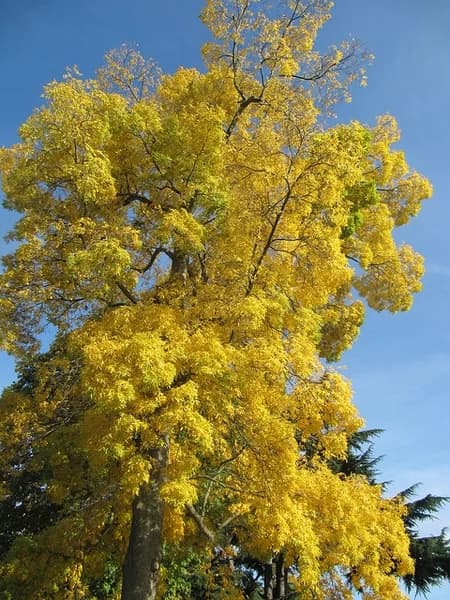
Yellow buds can be visible before leaf-out. Spring brings new compound foliage; summer shows its leaflets and developing nuts. Autumn foliage turns yellow before falling. Winter makes buds and twig arrangement easier to observe from an accessible place.
Botanical reference: NC State Extension’s bitternut hickory profile. This is a starting point for observation, not a complete identification key.
02 · Energy & character
Three qualities to contemplate beside the tree. Begin with what you can observe, then see what meaning emerges for you.
These tree-specific associations are new contemplative interpretations for the digital school. “Energy” here describes felt experience and symbolism; it is not a measured healing field or a promise of a particular effect.
A bud holds a form that is not yet a leaf.
Let an unfinished process remain unfinished while you give it suitable care.
What needs time rather than pressure?
Several features help distinguish one hickory from another.
Separate what you observed from what you assumed, leaving room to revise.
What do you know, and what are you guessing?
An established tree grows within the conditions of its place.
Consider a sustainable next step in something you intend to keep tending.
What small action supports your commitment?
03 · Practice with this tree · About 5 minutes
An original five-minute observation practice. Read once, then give your attention to the tree; sitting, standing, or observing from a distance are equally welcome.
Open outdoor practice →Choose stable, permitted ground and a comfortable seat or stance. Keep fallen nuts and living growth undisturbed.
Observe a visible bud, leaflet, or patch of bark. If it is too distant, use the photograph later rather than reaching for a branch.
Name one thing you actually see, then one interpretation you have added. Let both be present without needing a final answer.
Name a process you are tending and one modest action that supports it. Return to the whole tree and finish when ready.
Spend about five minutes, or less if that suits you. Keep your device available when needed. No touching, collecting, controlled breathing, or tree-supported movement is required; leave the tree and its surroundings undisturbed.
04 · Roots in the book
The book teaches attention and learning from trees. This page adds a species-specific encounter; it does not claim that the original book assigned these three energies to bitternut hickory.
Chapter 3 introduces three pathways and choosing an appropriate setting.
Read the chapter companionOriginal: printed pp. 13–17Chapter 4 encourages a sustainable beginning with five or ten minutes.
Read the chapter companionOriginal: printed p. 28Discernment, perseverance, and patience connect this new practice with Chapter 6’s invitations to learn from trees.
Explore Wisdom and WonderOriginal: Chapter 6, printed pp. 96–12405 · Notice for yourself
Reflect quietly or write a sentence in your own notebook. On another visit, look at the same detail again. Your experience may fit these themes, suggest something different, or simply be a few minutes of looking.