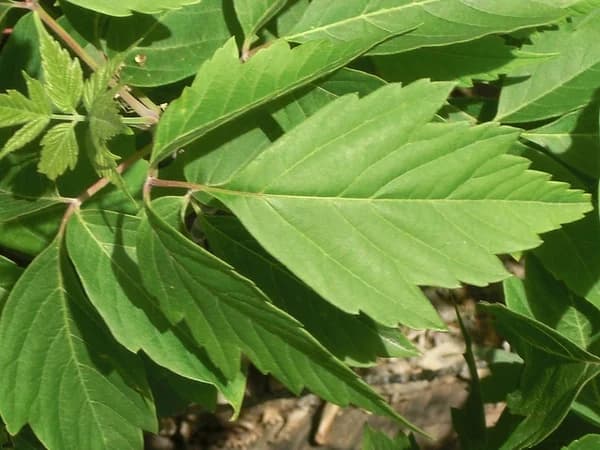
Acer negundo · Photo: Andrey Zharkikh · CC BY 2.0 · Source · Converted to WebP
01 · Meet the tree
Meet boxelder.
Boxelder is a maple with compound leaves, unlike the familiar single lobed leaves of many other maples. Its difference offers a place to practice looking carefully before deciding that you already know.
Leaves
Opposite, compound leaves often have three to five leaflets, sometimes more. Check the arrangement of whole leaves on the twig. Three leaflets alone do not establish identity and can resemble poison ivy; observe without handling unfamiliar plants.
Seeds and twigs
Female trees produce paired winged seeds called samaras. Male and female flowers occur on separate trees. Green young twigs and the compound foliage help distinguish it from other maples.
Place and care
Boxelder is native to North America and often grows near waterways and floodplains. Its wood can be brittle. Choose an established viewing place away from damaged branches, especially in wind or after storms.
Spring brings flowers and new compound leaves. Summer offers a fuller view of leaflets and paired seeds on female trees. Autumn foliage often turns yellow, and seeds may persist into winter. Bare branches make opposite twig arrangement easier to notice.
Three qualities to contemplate beside the tree. Begin with what you can observe, then see what meaning emerges for you.
These tree-specific associations are new contemplative interpretations for the digital school. “Energy” here describes felt experience and symbolism; it is not a measured healing field or a promise of a particular effect.
Flexibility
This maple has a leaf structure different from many familiar maples.
Let the difference prompt flexibility in your expectations. A category can hold more variety than a first impression suggests.
Where could you loosen an expectation?
Curiosity
One leaf divides into several leaflets.
Explore one detail before naming the whole. Curiosity can be a question you are willing to keep open.
What detail have you overlooked?
Renewal
Buds, leaves, or lingering seeds show one stage of the tree's season.
Use the visible stage as a prompt to begin from your actual circumstances. A fresh attempt can take a different shape.
What could you begin differently?
03 · Practice with this tree · About 5 minutes
Look again. Make room for difference.
An original five-minute practice for curiosity and flexible expectations beside a boxelder.
Sit or stand comfortably on permitted, stable ground away from damaged branches. Keep unfamiliar plants untouched. A view from a path is sufficient.
Separate leaf from leaflet
If visible, follow a whole leaf from its attachment toward its leaflets. If foliage is absent or distant, observe a twig junction instead. Do not strain to identify every part.
Notice your expectation
Describe what you see before adding a name. Notice whether it differs from what you expected. Let your breathing continue naturally while you look again.
Try a flexible next step
Bring a familiar task to mind. Choose one small change to try, without demanding a result. Return to the tree and finish when ready.
Let the visit be enough.
Spend about five minutes, or less if that suits you. Keep your device available when needed. No touching, collecting, controlled breathing, or tree-supported movement is required; leave the tree and its surroundings undisturbed.
The book teaches attention and learning from trees. This page adds a species-specific encounter; it does not claim that the original book assigned these three energies to boxelder.
Choose a tree with care.
Chapter 3 introduces three pathways and choosing an appropriate setting.
What changed when you allowed a familiar thing to look different?
Reflect quietly or write a sentence in your own notebook. On another visit, look at the same detail again. Your experience may fit these themes, suggest something different, or simply be a few minutes of looking.